

10 Jun Comparing plant milk nutritional content – which is the healthiest plant milk?
Hello. I’ve been thinking a lot about different plant milks and which one is better for our health.
I plan to compare and contrast the different milks at the super, because I recall Dr Karl on ABC saying that plant milks such as oat, almond, soy, probably coconut, macadamia, what else…? Pea? … don’t have much nutritional value.
He said they are quite unlike dairy milk which has protein, I’m not sure what else, I’ll be able to tell you soon.
Case against dairy milk
But, the thing with dairy milk of course is that it’s got all these immunoglobulins in them. And so, often people find that it’s kind of disgusting, it’s designed to feed the immune systems of baby cows basically. . . And we’re not cows, we have completely different immune systems.
I find that when I drink dairy milk my skin just goes totally greasy and get spots all over it. . . And then, I’ve got lactose intolerance, it causes my stomach to get upset. Even for people who aren’t lactose intolerant, it isn’t ideal. And that is statistically not many people, most people are pretty much lactose intolerant after the age of three.
However, if you drink milk all the time, your immune system manages it, And things like cheese, hard cheese have been processed in such a way with bacteria I think. So the lactose has been partially digested. So they’re not so allergenic.
Dairy milk nutrition
$6.00 for 2 litres, $6.80.
So it’s pretty much the same price as plant milk, or at a low – $4.95.
So it’s got fat, 10 grams of fat, 6 grams of saturated fat, so it’s not too good.
753 kilojoules per serving, and a serving is a cup, 250 ml.
Protein, 8.5 grams.
Carbohydrate, 11.5 g
Sodium, 113 mg
And calcium, 295 milligrams.
Plant milk – Almond milky
Gee. It has 88 calories, 363 kJ, so it’s half the calories.
1.8 grams of protein, 6.8 grams of fat.
And 0.5 grams of saturated fat.
Polyunsaturated fats, 1.5 g.
Monounsaturated fat, 4.8 g.
No cholesterol.
Carbohydrate, 3.8 grams.
Sugars, 3.3 g.
Dietary fiber, 2.5 g.
Calcium, 300 milligrams.
Sodium, 163 milligrams.
Vitamin E, 2.3 milligrams.
Vitamin D, 1.25 micrograms.
Plant milk – oat milky
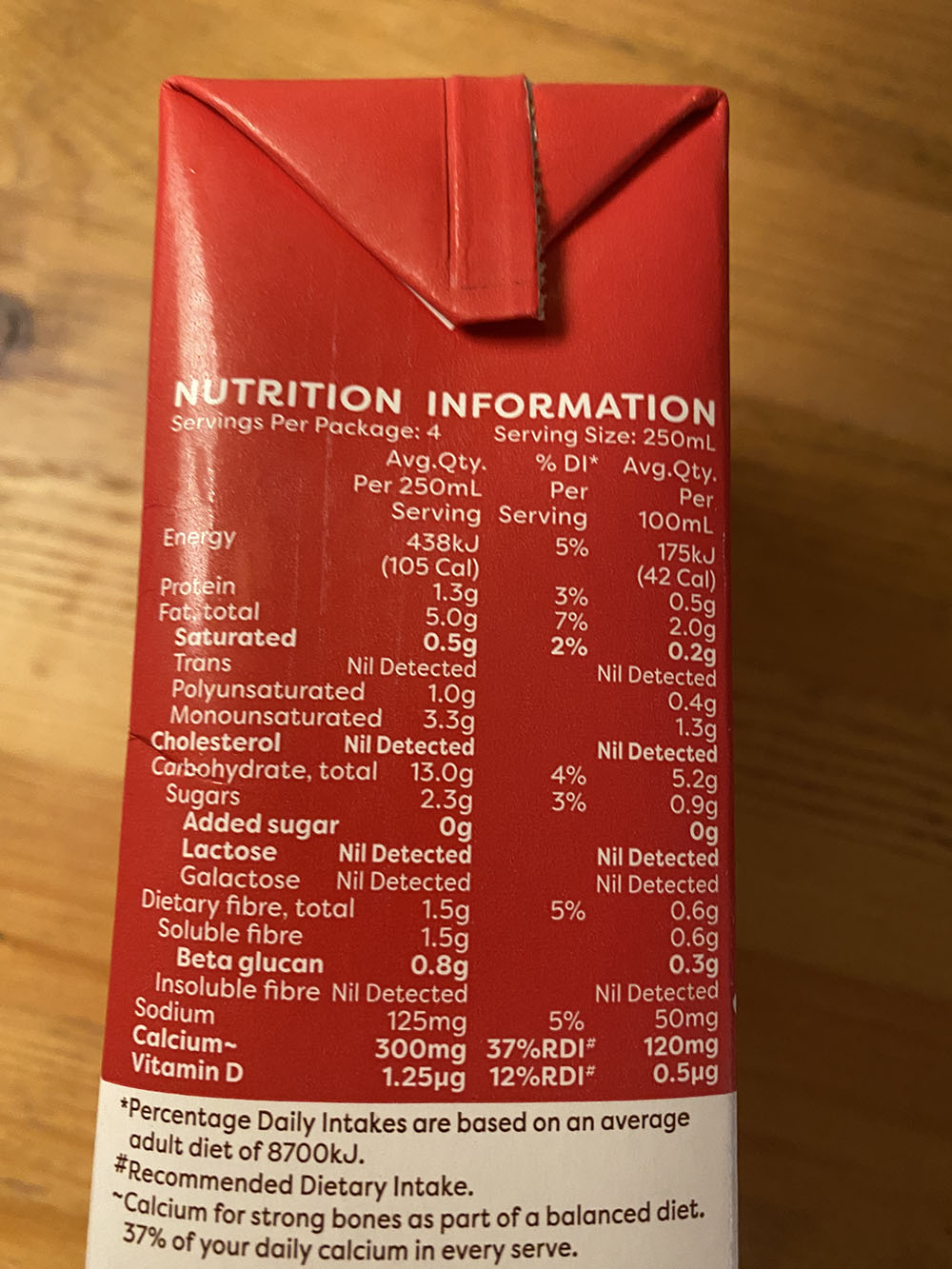
It has quite a lot of carbohydrates now.
And it’s actually got quite a lot of sugars.
So you kind of have this sugar hit.
438 kilojoules.
105 calories.
1.3 grams of protein, so a little bit less. – Heaps less than milk.
5.0 grams of fat.
Saturated 0.5 grams.
No cholesterol.
Carbohydrate, 13 grams. – I think that’s even higher than milk.
Sugar is 2.3 grams.
It doesn’t have any lactose.
It has 1.5 grams of fiber.
Soluble fiber, 1.5.
And beta-glucan, 0.8 g.
There’s quite a lot of sugar in a chug of milk.
Sodium, 125 milligrams.
Calcium, 300 milligrams.
And vitamin D, 1.25 micrograms.
So the problem is that it’s got 13 grams of carbohydrates, which is sort of starches from the oats. Except dairy has 11 g of carbohydrates! So it isn’t exactly a LOT worse than that!
So the only real other one is soy.
There’s coconut.
Rice, I think rice is not so good.
Soy
98 calories.
405 kJ.
It’s higher in protein. – 7.5 grams of protein.
4.5 grams of fat.
No cholesterol.
6.2 grams of carbohydrates.
4.0 grams of sugar.
0.5 grams of fiber.
200 milligrams of sodium.
And 300 milligrams of calcium.
Rice milk
463 kilojoules, 0.8 grams of protein.
No cholesterol.
Carbohydrate. 20 grams of carbohydrates.
And 14.5 grams of sugar. – So that’s quite a lot.
0.5 grams of dietary fiber.
So that’s the worst one so far with so much sugar.
Should we look at the coconut?
Energy, 605 kilojoules.
1.3 g protein.
So it’s about the same fat – 6.8 grams.
Carbohydrate, 19.5 g.
Sugar is 9.5 g.
Dietary fiber less than 1g – So that’s not very good either.
It’s pretty much the same as rice milk.
So it just feels like almond milk might be the best. But the problem is that almond milk doesn’t have beta glucan like oat milk does.
Lactose free milk
I tried lactose free yoghurt once. It made me feel worse if anything. I think it is too processed.
It’s 678 kilojoules.
8.5 grams of protein.
8.5 grams of fat.
12.3 grams of carbohydrates.
Sugars 12.3 g.
Sodium 120 mg.
Calcium 330 mg.
And riboflavin 0.8.
Discussion
So the general consensus is that soy is the most nutritious of the plant milks and I did try to switch to it because of the sugar in oat milk, however, as we can see from this comparison soy milk still has over 6 g of carbohydrates. And it doesn’t have beta-glucan that oat milk does. It also has phytoestrogens which can have a problematic effect. And higher protein than oat or almond milk.
I also found that when I swtiched from oat milk to soy I felt so strange. It may have been withdrawals but I did give it a good go. Even a week after switching to soy my gut-brain connection was all out of whack and I felt not great at all. I couldn’t think properly.
So after becoming concerned again with the amount of carbohydrate (starch) in oat milk I decided to supplement with almond milk because I think even though it doesn’t have as much protein you can add protein.
The problem with oat milk is the starches which get digested into sugars so they still are pretty much sugars, even if it doesn’t happen instantly and there is some fibre which can be deducted from the total amount of carbohydrate, but not a lot!
With almond or oat milk you’re getting a little bit of fibre when you drink it. Because the two things that I’m aiming for is protein, about 1.8 grams per lean kg of body mass, and about 30 to 35 g of fibre every day.
Environment, blood sugar or body composition?
And I guess it does depend on your aim. It can be good to try and do just a couple of things, but I do want to reduce sugar, and oat milk is a pretty big whack of sugar with coffee. Especially if you haven’t had something to eat beforehand, which you definitely should!
So it’s not ideal, I think.
So in terms of which one’s the best, plant milk, I guess that’s up to what your goals are.
If you’re looking for fibre and protein, maybe soy milk is for you if it doesn’t have such a bad effect on you as it did me.
However, if you’re interested in reducing your carbohydrates, almond milk is probably the better. The problem is that almond milk isn’t as good for the environment, as oat milk, as it uses a lot of water. So, that’s another consideration.
From Claude:
Almond milk does have a real environmental problem, but it’s specific: almonds require a huge amount of water, and around 80% of the world’s almonds are grown in drought-prone California. The water footprint per litre of almond milk is roughly 3–4x higher than oat milk. Almond farming also relies heavily on managed bee pollination at a massive scale, which has welfare implications.
Oat milk performs better on water use and land use, and oats are typically grown in more water-abundant climates. It’s not perfect — there are pesticide concerns with conventional oat farming — but on balance oat milk is generally considered the more environmentally sound choice among the popular alternatives.
So yes, if environmental impact is your concern, oat milk is the better swap.
Claude also questioned if the amount of carbohydrates in an oat coffee is really a big deal.
100ml of oat milk (barista style) is roughly:
6–9g carbohydrates
0–1g fibre
3–5g sugarsSo yes, more than a trivial amount — comparable to about half a slice of bread. If you’re having two or three coffees a day, that’s 20–25g of carbs from milk alone, which is worth knowing about.
For context though:
A flat white or latte with 200–250ml of regular cow’s milk has around 10–12g of carbs (lactose), so oat milk at 100ml isn’t dramatically worse than what a lot of people are already drinking. Almond milk at the same volume is only about 1–2g of carbs, so the gap there is real if you’re carb-conscious.
How much it matters depends on your goals:
If you’re just eating a generally balanced diet with no specific carb targets, 6–9g per coffee is background noise
If you’re in perimenopause or managing blood sugar, insulin sensitivity, or body composition actively, those carbs from a liquid source (no fibre to slow absorption) are worth factoring in
If you’re doing lower-carb eating intentionally, almond milk is the more compatible choice.
Then Claude came out and said something very funny. ‘Some people ask for a half oat, half almond coffee’. It makes me laugh because of all the ridiculous preferences that people have with their coffees, and I am not sure I would have the audacity to add the fuss to my coffee order in the morning, but I might ask if it would be too much trouble. Maybe half oat, half soy, since Claude agreed with all the other advice I have heard that soy is the most nutritious of the plant milks with higher protein and reasonable fat and carbohydrate.
The point is that we shouldn’t really be drinking a lot of liquid calories or carbohydrates in any case, but if we are exercising and eating a balanced diet, it is probably not going to make that much difference if you are having one or two coffees a day.
When I was a child one of my friend’s younger brothers was lactose intolerant, so their mother would put orange juice on his cornflakes, , , ah, ,, my – how things have changed! I used to like overnight oats with orange juice too. They call that Bircher muesli no? Now I think about the sugar hit and shudder, even though apparently it is better to eat carbohydrates in the morning and after weight training.
No Comments